Card 02 · From Chapters 3–4
The Flip Card
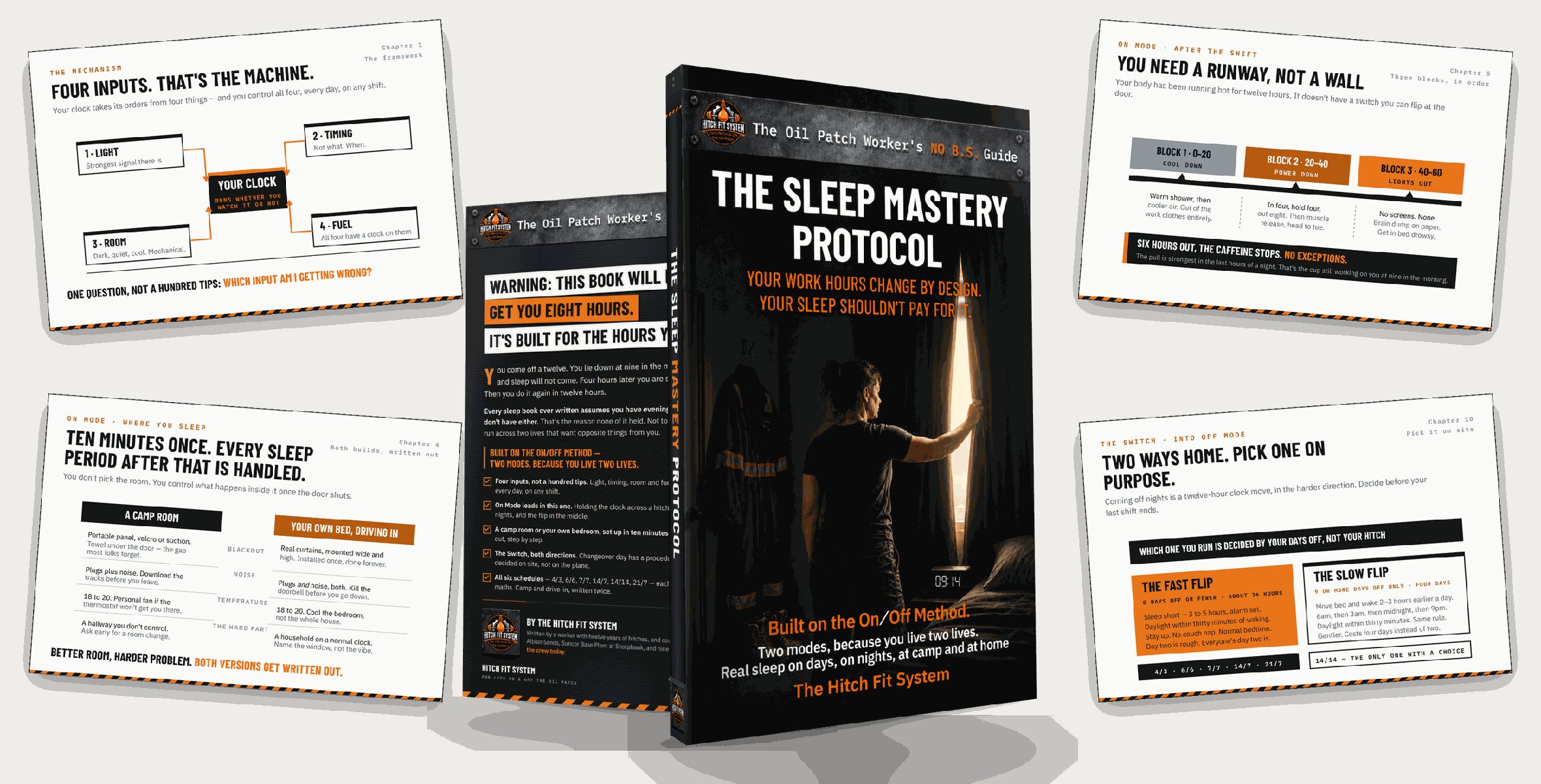
Days to nights, mid-hitch, written out step by step. Four inputs with clock times attached. The camp room build on one side, your own bedroom on the other — because they are not the same problem.
Breaking News: Oil Patch Workers!!
You come off a twelve. You lie down at nine in the morning, wrecked. And nothing happens. Forty-five minutes of ceiling, then four hours of broken sleep.
15 chapters · 6 bonus tools · 82 tagged procedures · 6 schedules
Book · audiobook · 1 field card · App free 120 days, then $27/mo, cancel anytime · Full refund inside three hitches, keep everything
Or take all five — Founding Crew $197 · 100 seats · Closes October 10
Get all five instead — $197 →Get all five — The Complete System $297 →
From a camp room at Fort Hills
Wood Buffalo, Alberta.
Thursday, 9:14 a.m.
Dear oil patch worker,
You come off a twelve. You lie down. You are wrecked enough to sleep standing up.
And nothing happens.
Then this is the best $67 you'll spend this year.
Here's why.
I'm not going to give you my name. It isn't the part that matters.
Here's the part that does. Twelve years of hitches, and counting.
Nexen Long Lake. Albian Sands. Suncor Base Plant at Steepbank.
Nine years at Fort Hills, where I still work today.
I am not a coach. I have never had a client. I have a badge, a locker, and a bus at 5:30 like you do.
Site trained me properly. Lockout tagout. Confined space. Fall protection. H2S.
Nobody ever handed me a procedure for the twelve hours a day that happen after I clock out.
So I did what everybody does. Four coffees and two cans to get through the back half of a hitch.
A couple of beers on days off to come down. Then waking at two in the afternoon feeling like a service truck went over me.
And telling myself this is what the money costs. I said that out loud, on a crew, more than once.
Here's what used to get me. It was never the falling asleep once.
I could nail one hitch. Then the next one flipped me to nights and everything I'd figured out was useless.
Or I'd get the room right and blow it walking out into full sun without shades.
Or I'd get all of that right and drink a coffee at four in the morning to finish the shift.
One thing at a time, each one undoing the last.
Then I read one of those sleep books properly, on a day off, at my own kitchen table.
And I found what had been beating me. It was on about page four of every one of them.
Every sleep book I'd ever picked up assumed four things about my life.
I get none of the four for half the year. And all four for the other half.
That is not one situation. That is two. And they want opposite things from you.
Once I saw it, I couldn't unsee it.
So I stopped trying to have more discipline. I built two modes instead of one.
One for on hitch. One for days off. And a procedure for the changeover, both directions.
Because the changeover is where the whole thing was actually falling apart.
I ran it on 4/3. On 7/7. On 14/14.
Out of a camp room. Driving in from town. Through flips, turnarounds and call-outs.
One stretch, my blackout was a garbage bag and painter's tape.
It held. Hitch after hitch after hitch.
Not perfectly. I'll say that more than once on this page.
But it held. Nothing else ever had.
Folks on my crew started asking what I was doing differently.
I'd explain it in a hallway at shift change. That's a terrible way to teach anybody anything.
So I wrote it down. Fifteen chapters. Six bonus tools. 82 procedures. Every one tagged, so you know whether to run it on hitch, on your days off, or on a changeover day.
It's called The Sleep Mastery Protocol, and it is the one I'd start with.
Run it on your next hitch. Not next January.
Run It On Your Next Hitch — $67Book · audiobook · 1 field card · App free 120 days, then $27/mo, cancel anytime · Full refund inside three hitches, keep everything
Or take all five — Founding Crew $197 · 100 seats · Closes October 10
Get all five instead — $197 →Get all five — The Complete System $297 →
Who this was built for
Nodded at even one? Keep reading.
The rest of this page is about what's actually beating you. It isn't the mattress. It isn't your toughness.
First, the door
Still here? Good.
The arithmetic nobody outside the gate does
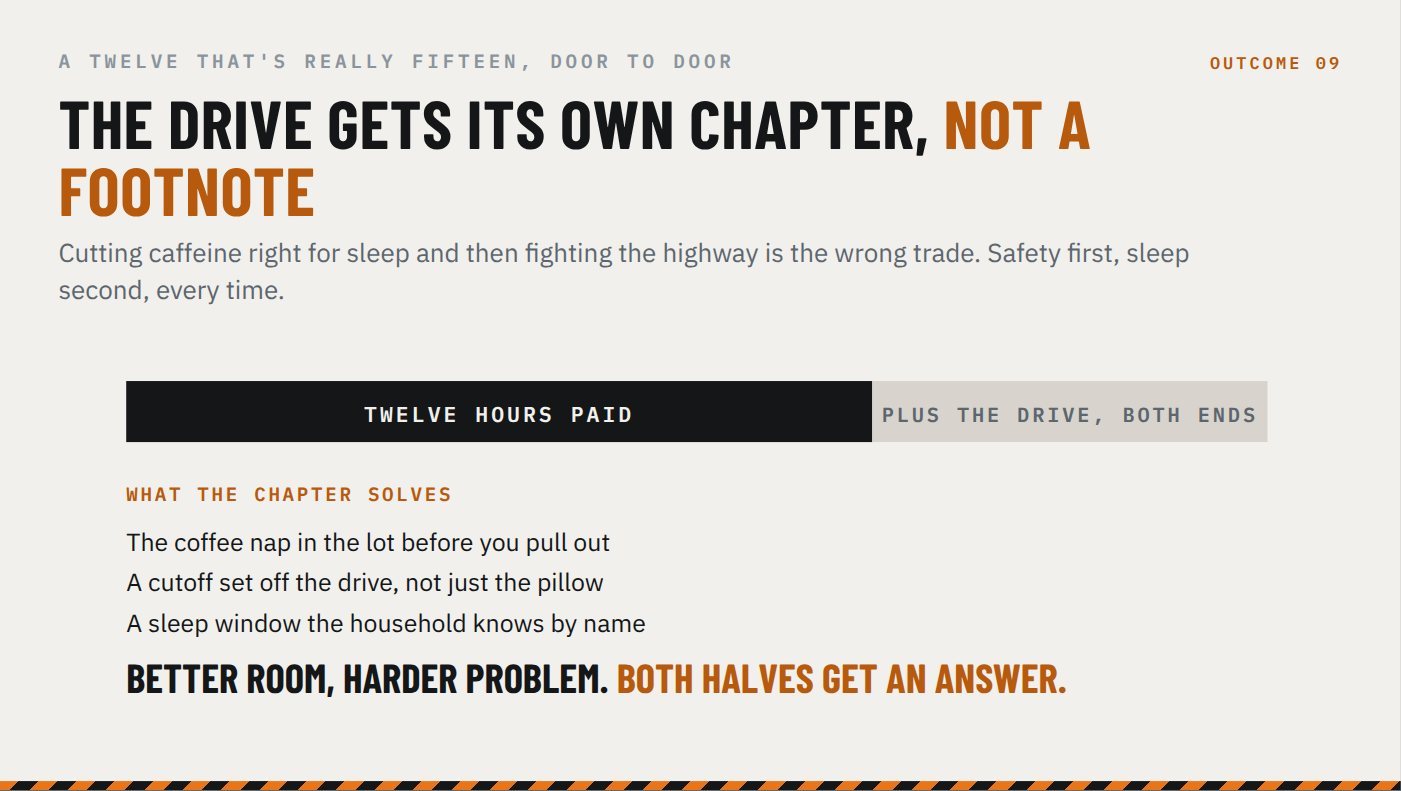
Your shift is twelve. Add the drive or the bus on each end and it's fourteen or fifteen, door to door.
What's left has to hold your eating, your training, your family and your sleep.
Sleep is the one that gets cut, because it's the only one nobody's waiting on.
You come off a twelve-hour night. Boots off, gear racked.
Adrenaline still running, because your brain doesn't know the shift is over just because the clock says so.
Maybe you're walking a camp hallway while the day crew starts to move.
Maybe you're forty-five minutes down the highway with the sun coming straight through the windshield.
Either way you lie down. You should be out in ten minutes.
Instead: forty-five minutes of ceiling. Four hours of sleep. Awake with your heart going for no reason.
Then you do it again in twelve hours.
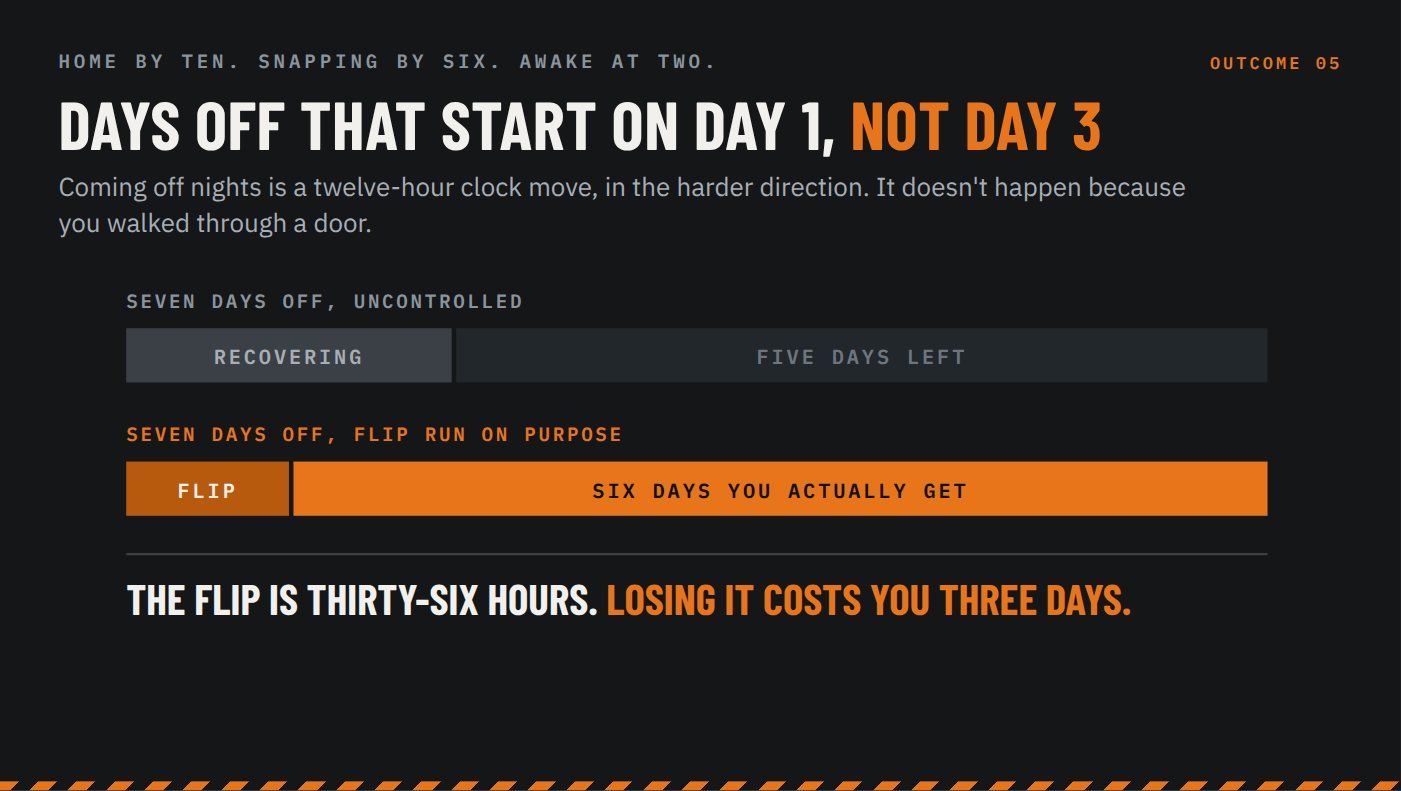
Day one you're fine. You slept like a person on your days off.
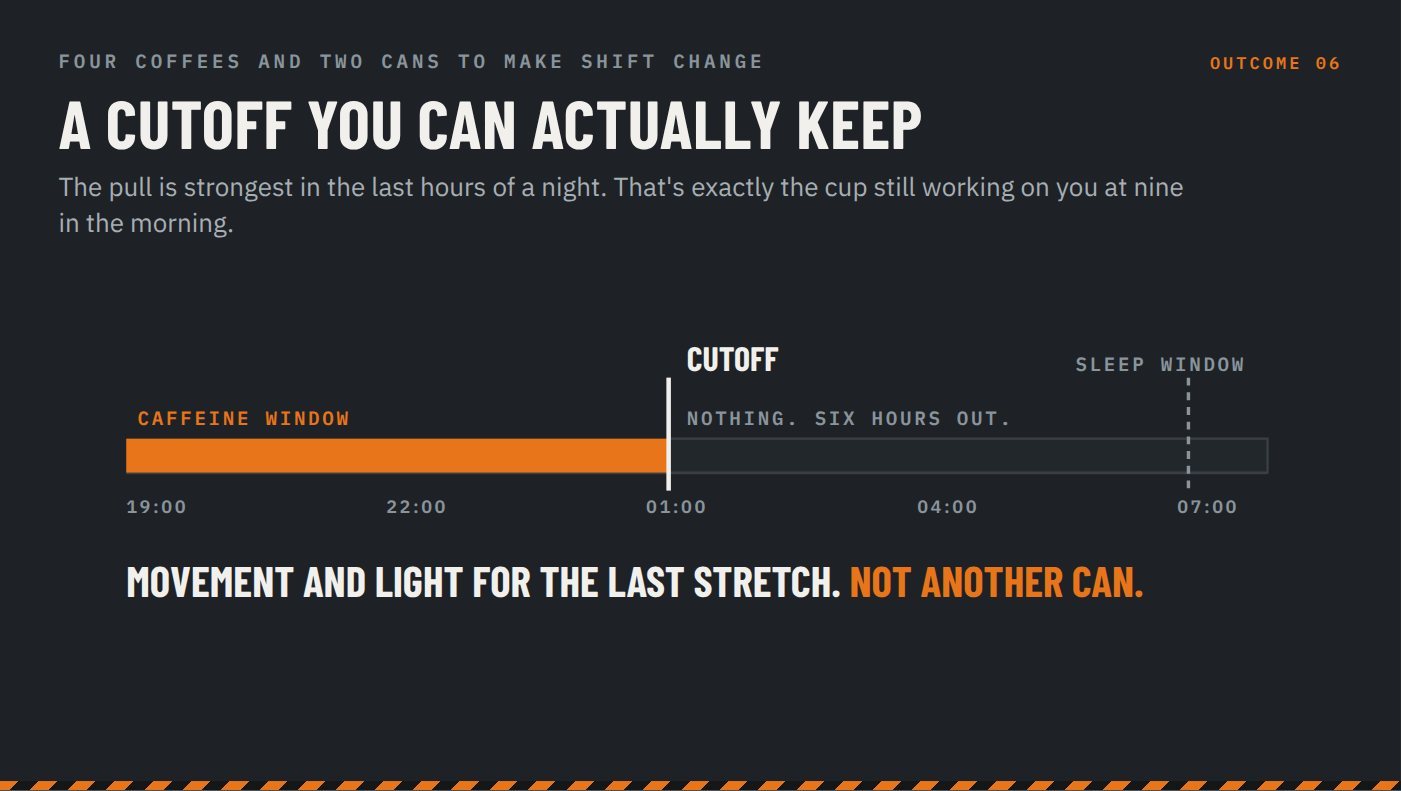
By the back half you're on four coffees and two cans just to make shift change.
On a 4/3 that's day three. On a 7/7 it's day five. On a 21/7 it's a stretch you stop counting.
You get short with people. You make a call you'd never make rested.
And it never shows up on a report as fatigue. It shows up as "worker didn't notice."
Folks don't get hurt because they're bad at their job. A lot of them get hurt because they haven't slept properly in a week and nobody flagged it, including them.
You finish your last night and fly home Wednesday morning.
Two weeks of sleeping days, and a house that runs on a normal clock.
By six you've snapped at your oldest over shoes in the hallway. By nine you're asleep on the couch.
At two in the morning you're wide awake while the house sleeps around you.
On a 4/3, that's all of your days off. On a 7/7, it's most of them.
And your partner has quietly started expecting the first day or two home to be rough — without ever being told why.
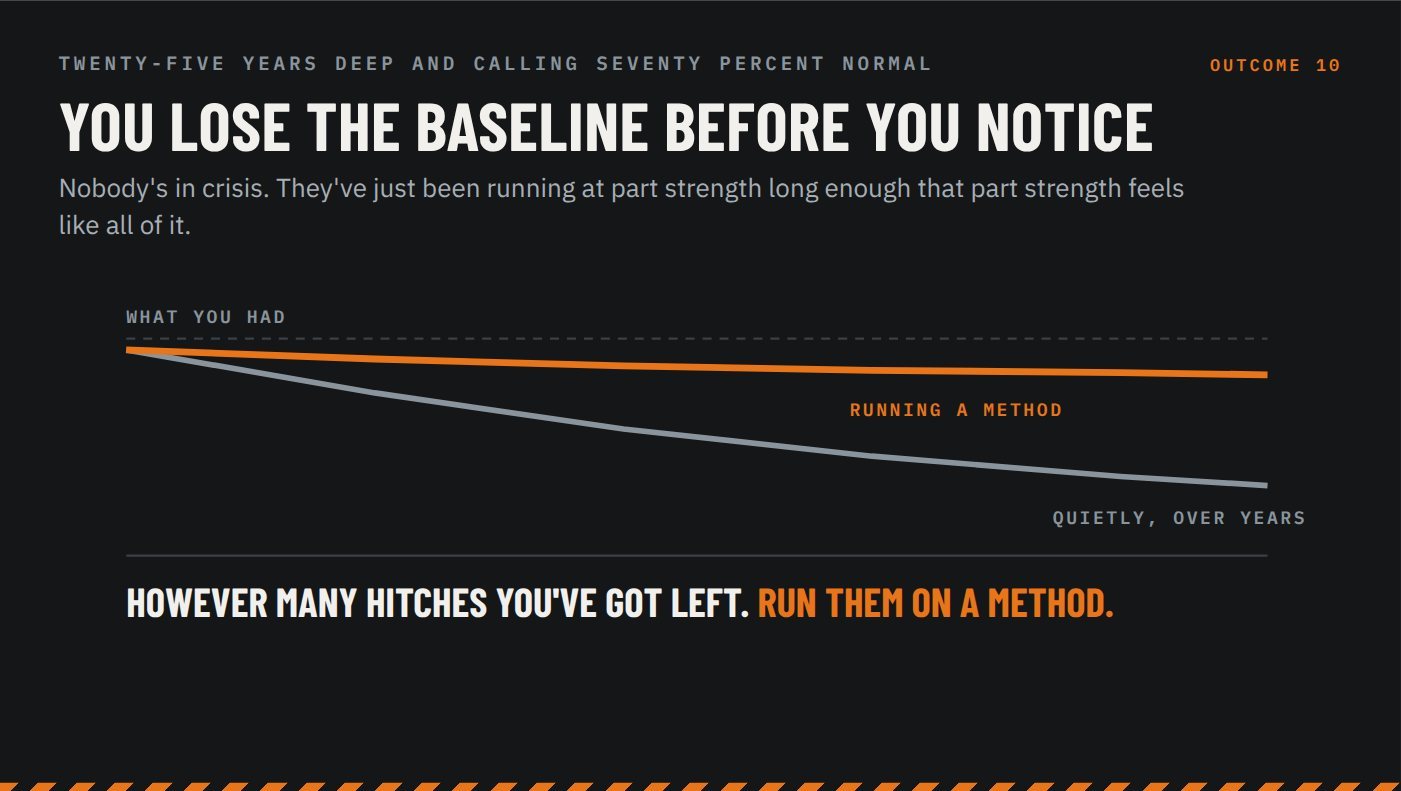
There's somebody on your crew twenty-five years deep. Tough, respected, never complains.
Four coffees and two cans at site. A couple of beers most nights at home to switch off.
Never once blacked out a room, because it's never bothered him before.
He isn't in crisis. He's running at maybe seventy percent, every day, for years.
And he has no idea, because he's got no baseline left to compare it against.
Fix the one that everything else sits on.
Get The Book, The Audiobook And The AppBook · audiobook · 1 field card · App free 120 days, then $27/mo, cancel anytime · Full refund inside three hitches, keep everything
Or take all five — Founding Crew $197 · 100 seats · Closes October 10
Get all five instead — $197 →Get all five — The Complete System $297 →
Why this one holds when the last four didn't
One set of rules cannot cover both halves of your year. So there are two, and a changeover in each direction.
Light, timing, room and fuel, run on a shift that fights all four. This is where this Protocol lives.
Paying down debt without wrecking the clock, and habits that survive contact with a normal week.
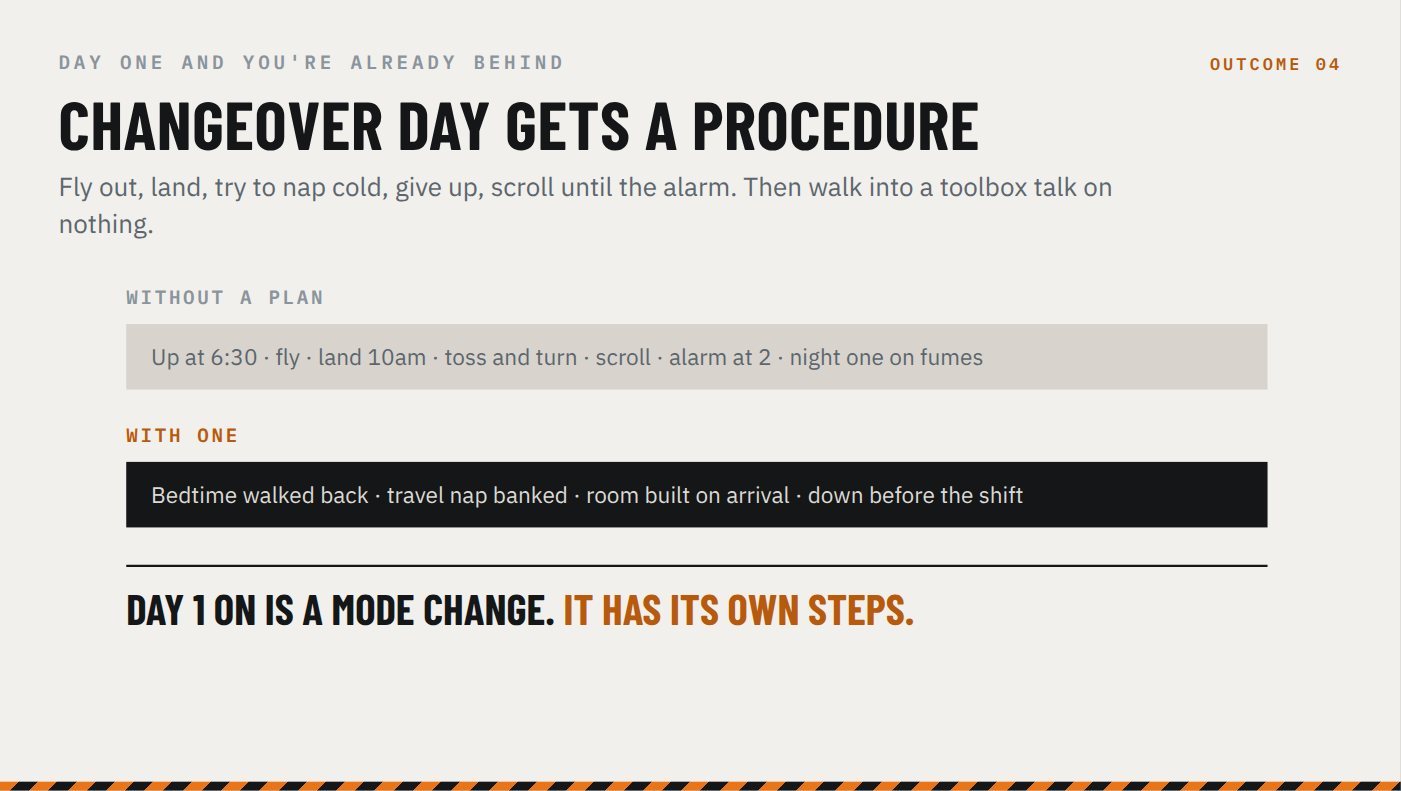
Day 1 on and Day 1 off are both mode changes. Each has its own procedure, decided in advance.
Here's what makes this one different from its four siblings.
Every other Protocol in this system pays off at home. This one mostly pays off out there.
In the room you're trying to sleep in at nine in the morning. While the world runs on a normal schedule around you.
On Mode leads. That's the whole design.
Your body runs on an internal clock that decides when you're sharp and when you're finished.
It doesn't care what your schedule says or how badly you want to sleep like a normal person for once.
That clock takes its orders from four things. You control all four, every day, whether you know it or not.
That's the whole framework. Four inputs, applied to problems you're actually having.
So when something isn't working, you're not guessing. You ask one question: which input am I getting wrong right now?
Inside the book
This is the domino. Everything else gets easier after it.
Sleep On Your Next Set Of NightsBook · audiobook · 1 field card · App free 120 days, then $27/mo, cancel anytime · Full refund inside three hitches, keep everything
Or take all five — Founding Crew $197 · 100 seats · Closes October 10
Get all five instead — $197 →Get all five — The Complete System $297 →
The changeover half
Gear, fuel and the stuff nobody tells you
Pack it right once. Stop thinking about it.
Fix The Room Before The Next FlipBook · audiobook · 1 field card · App free 120 days, then $27/mo, cancel anytime · Full refund inside three hitches, keep everything
Or take all five — Founding Crew $197 · 100 seats · Closes October 10
Get all five instead — $197 →Get all five — The Complete System $297 →
The part you actually carry
A book is for a day off and a couch. It is no use at all at 4:30 in the morning when the schedule has just turned you inside out.
So the thing you’ll run most often came out of this book and onto a single page. Print it, fold it, put it in the kit bag. It’s in the app too, but paper doesn’t need a signal or a battery.
New, and it doesn’t exist anywhere else. Pulled straight out of chapters you’re already buying.
Card 02 · From Chapters 3–4
Days to nights, mid-hitch, written out step by step. Four inputs with clock times attached. The camp room build on one side, your own bedroom on the other — because they are not the same problem.
Take all five Protocols and you get all five cards.
Before you decide I'm the same as the last four
So how is this actually different?
It isn't a tip list. It's four inputs, two modes, and a procedure for every situation you'll actually be in.
And it was written by somebody who is still in a camp room tonight, not somebody who read about one.
Fair enough
Three excerpts, unedited, straight out of the manuscript. Click any card to bring it forward.
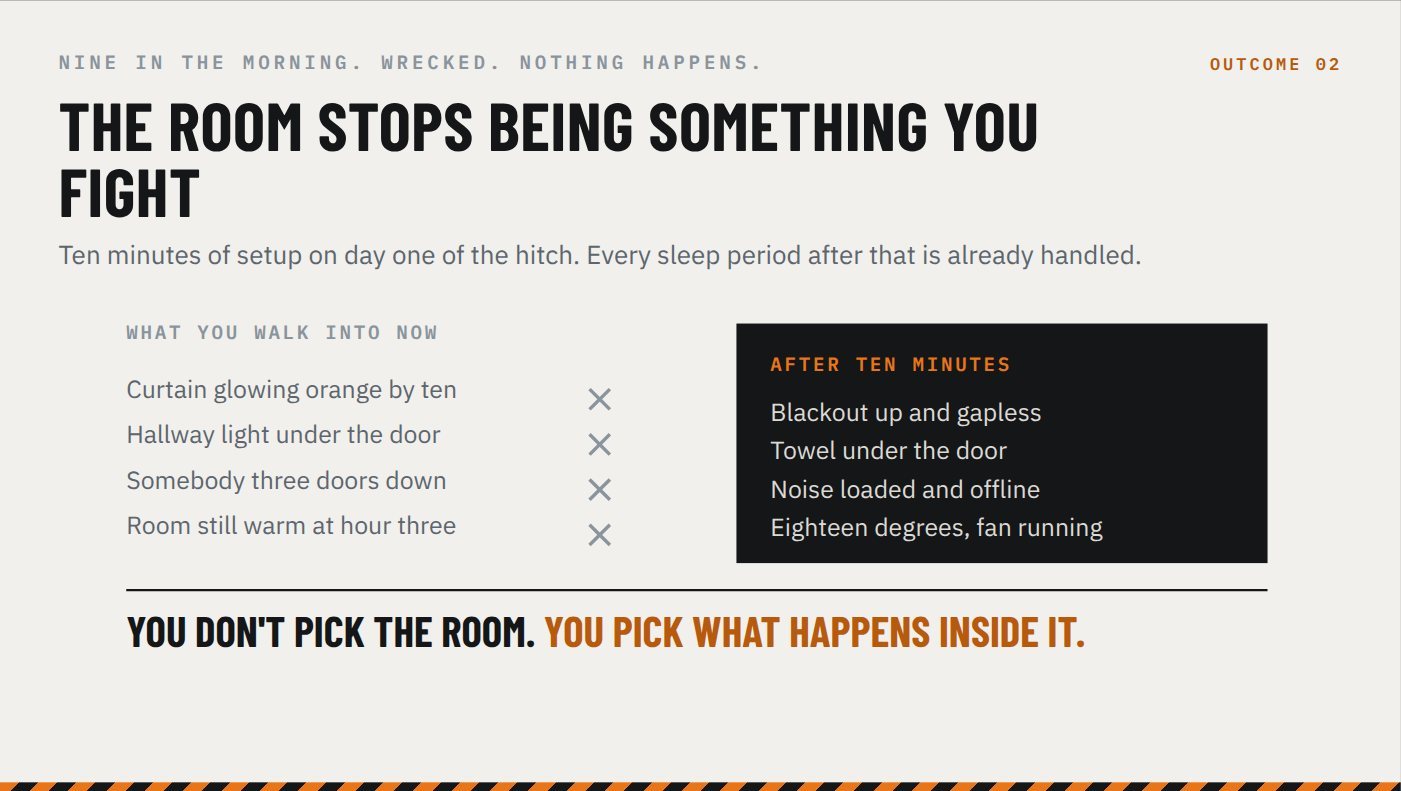
You know the room. Thin curtains that glow orange by mid-morning. Walls thin enough to hear somebody three doors down clear their throat. A mattress that's been through more hitches than you have.
HVAC that either blasts dry heat or turns the place into a meat locker, nothing in between.
You don't get to pick the room. You get what you get. You absolutely control what happens inside it once the door shuts.
Towel or a draft stopper under the door. Kills hallway light leak instantly. This is the gap most folks forget entirely because they're focused on the window.
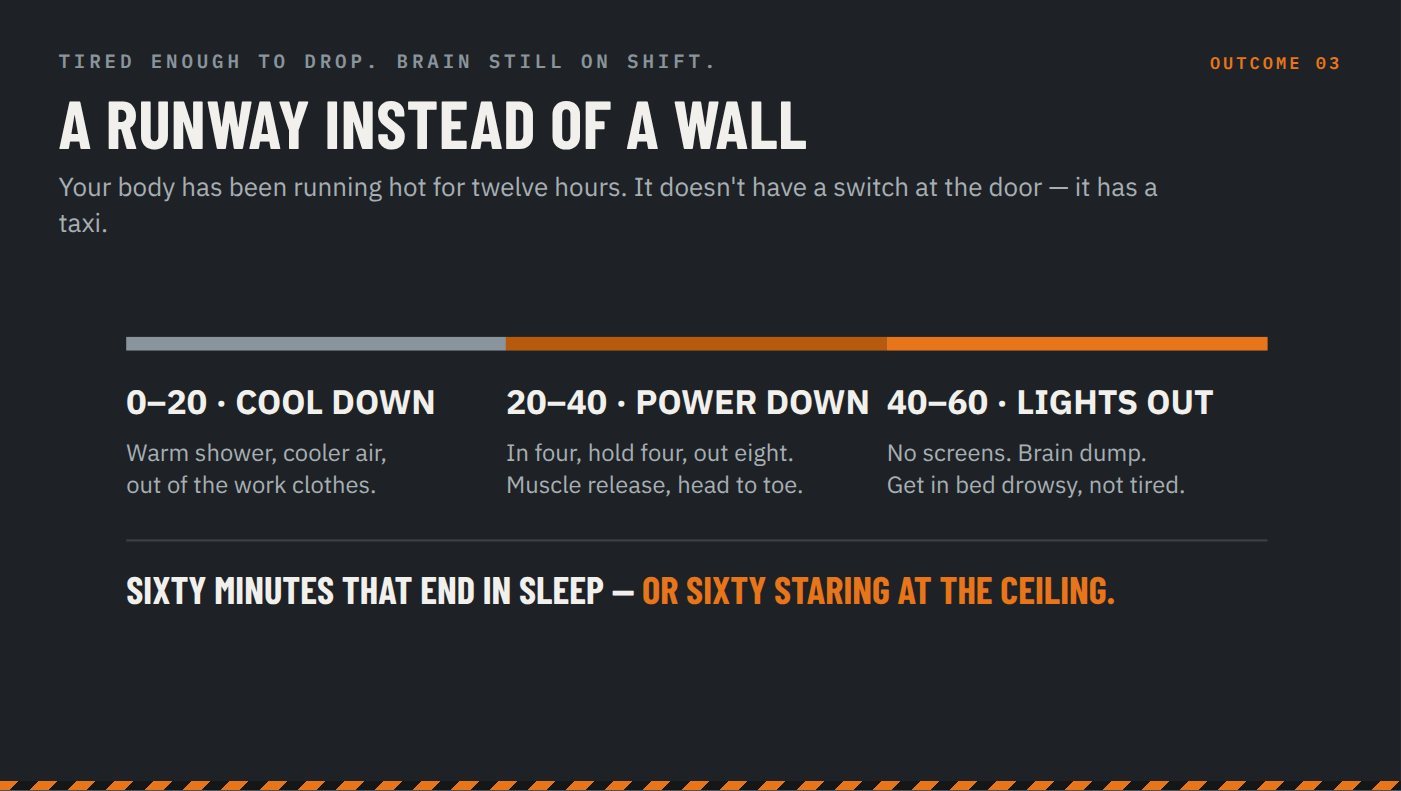
Your body doesn't have an off switch you can flip the moment the shift ends. It's been running hot all day. Alert, ready to react, primed for a place where staying sharp actually matters.
Going straight from that to "lights out, sleep now" is like flooring it. Then expecting the truck to stop the second you lift off.
You need a runway, not a wall. That runway is sixty minutes, in three twenty-minute blocks.
You're not choosing between sixty minutes of wind-down and sixty minutes of extra sleep. You're choosing between sixty structured minutes that end in sleep. Or sixty-plus unstructured ones that end in the ceiling anyway.
Decide before you finish your last shift. Not in the truck, not at the terminal, not lying on the couch at two in the afternoon wondering what happened.
The reason is simple: the fast flip starts the moment your last shift ends.
If you haven't decided by then, you've defaulted into the worst version. An uncontrolled crash, then three days of chaos.
Day two is rough. Expect it. You'll wake up feeling like you've been hit by something, and you'll be tempted to conclude the flip failed. It didn't. This is what day two is.
The part where a page like this usually shows you 6,000 five-star reviews
This launches on September 10, 2026. Nobody has run three full hitches on it yet.
I could invent a quote from "D.M., Pipefitter." You'd know. I'd know.
This crowd can smell a fake quote through a phone screen. And once you'd caught one, you'd rightly stop believing the rest of the page.
So here's what I've actually got instead.
When there are real ones, they'll go here. Not before.
What the research actually says
Researchers followed fly-in fly-out workers and measured both halves of the cycle.
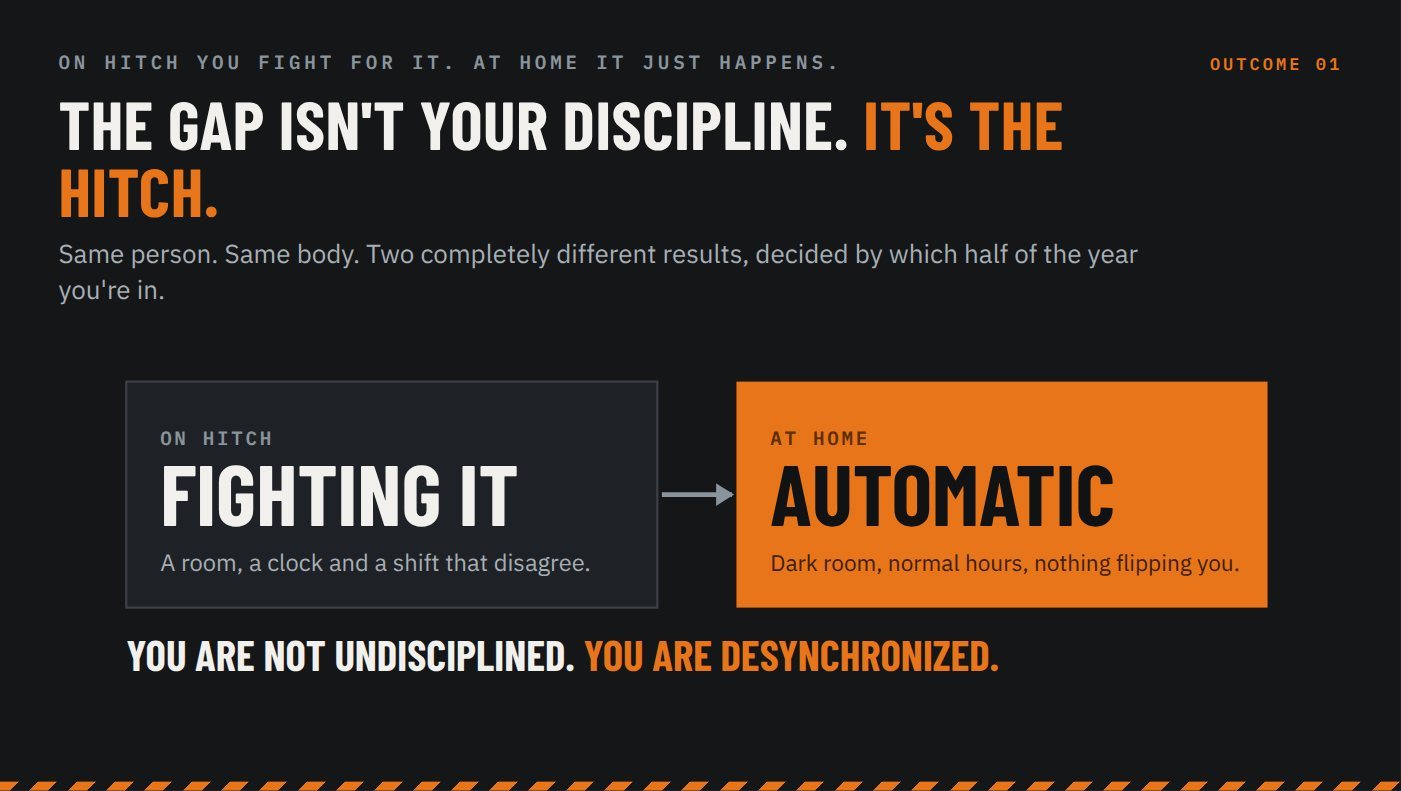
On shift, they averaged 6.3 hours, and 46.3% rated the quality as good. Off shift: 7.5 hours, and 78.2%. (Asare et al., International Archives of Occupational and Environmental Health, 2022.)
Read that again, because it's the whole argument.
On hitch, fewer than half of them get sleep they'd call decent. At home, four in five do.
Same people. Same bodies. The variable is the hitch.
That gap is not your discipline and it never was. It's measured, it's documented, and it's the thing this book is built to work on.
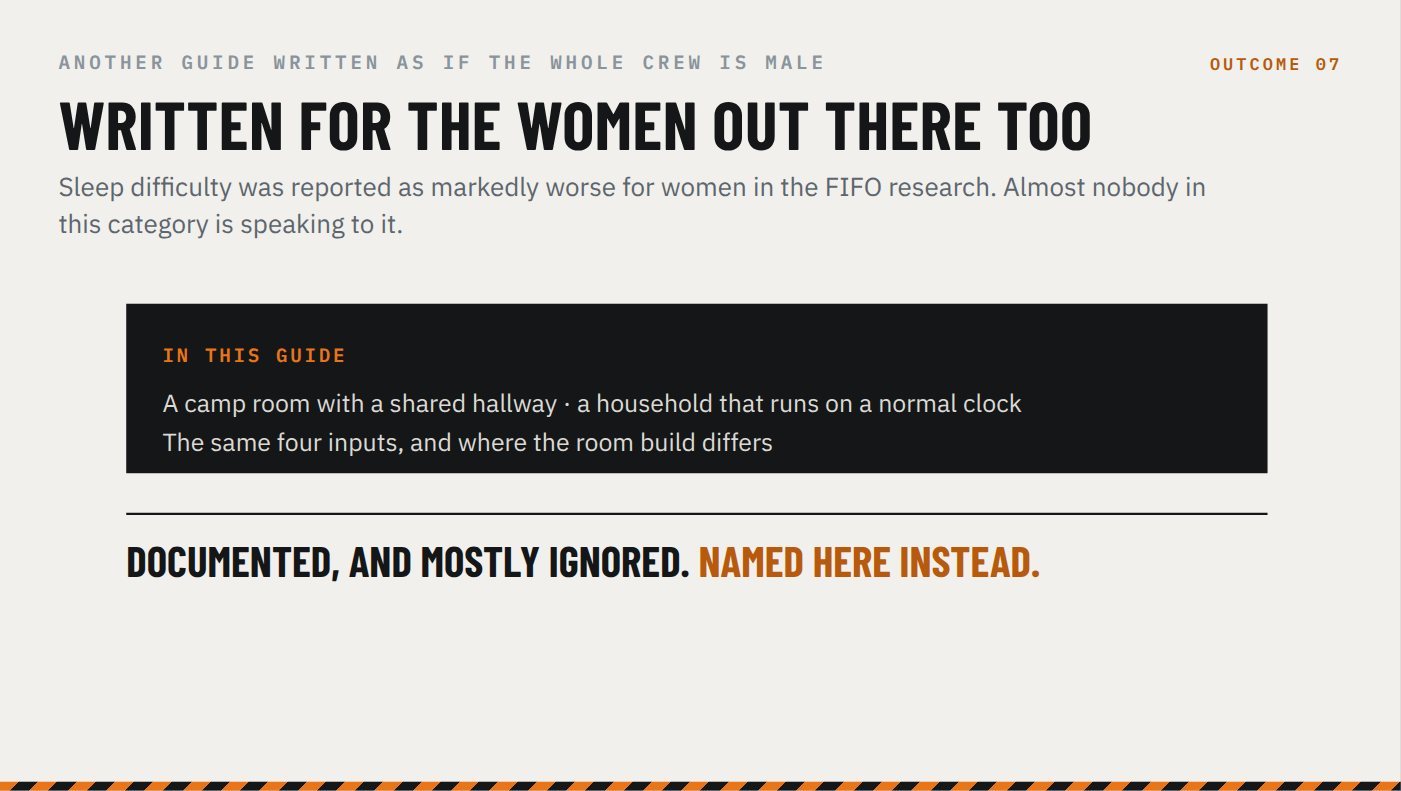
One more finding worth naming. In the University of Alberta research on this workforce, sleep was reported as a challenge for many workers. And notably worse for women.
Almost nobody in this category is speaking to that. This guide is written for men and women both, and says so.
Both of those describe a problem. Neither is a promise about your results, and you won't find one on this page.
Built for your schedule. Whatever it is.
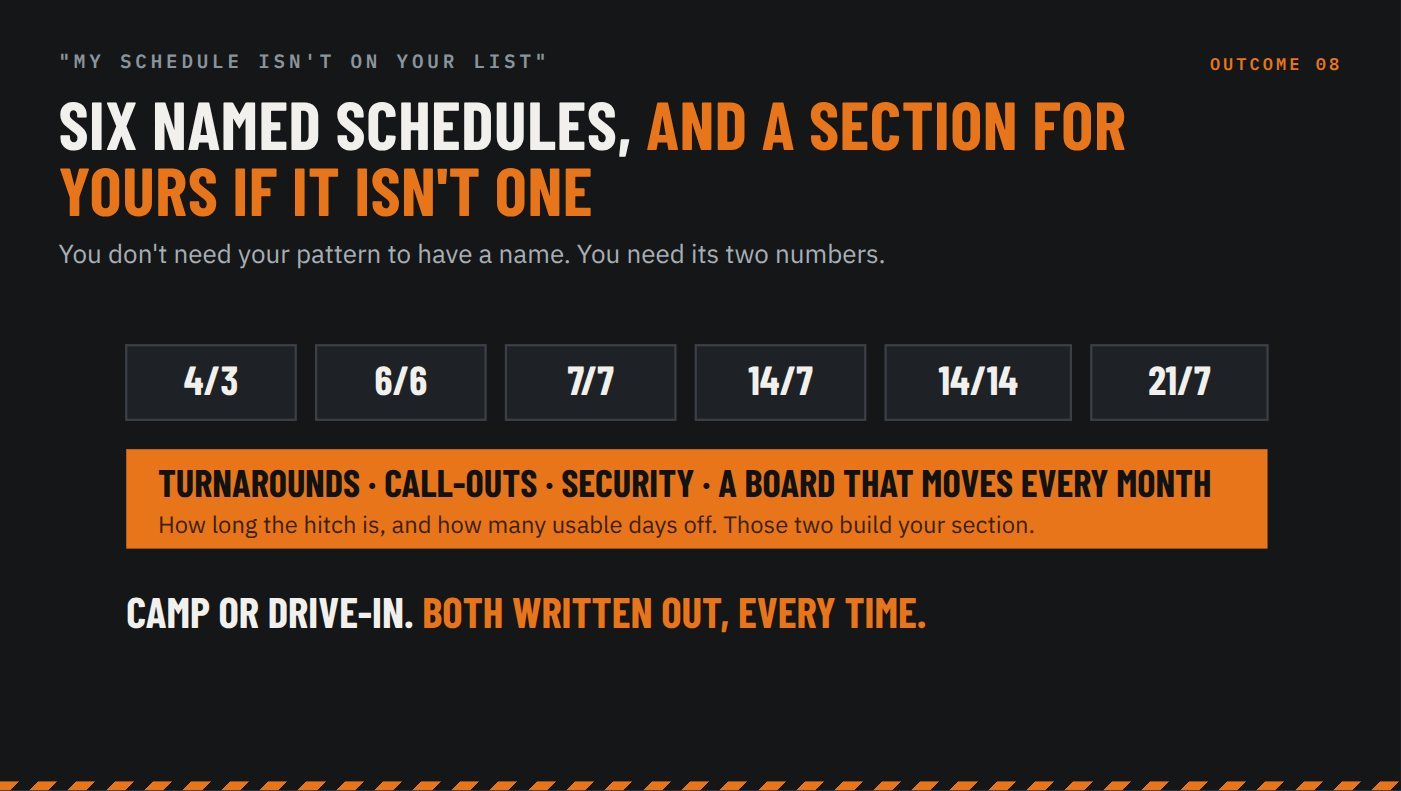
Each one gets its own debt maths and its own flip rule, because they are genuinely different problems.
A 4/3 has the best deal in the industry and the least warning about how to protect it.
A 21/7 usually buries a shift change in the middle. So the flip home is your second clock move, not your first.
And if your pattern isn't on that list, the last section of Chapter 8 is written for you specifically. You don't need a name for it. You need its two numbers.
Every procedure in this book is written twice where the two differ.
Commuters get their own chapter. A fourteen-hour door-to-door day and a household on a normal clock is a different problem entirely.
Night shift gets four steps. Day shift gets three, and they aren't the same three with the times swapped.
Flipping days to nights mid-hitch gets its own procedure, because that's where a lot of hitches come apart.
Operators, scaffolders, pipefitters, welders, millwrights, electricians, insulators, labourers, turnaround crews, safety, security, camp staff, engineers on a 4/3.
Your clock doesn't know what your ticket says.
No section of this assumes the crew is male. Where the research says the picture is different, the book says so.
What running it actually does
Nobody puts a plaque on the wall for any of that. You'll notice it anyway.
And notice what isn't on that list: a number of hours. This book promises the setup and the method. What your body does with them is between you and your body.
What lands in your inbox, in about a minute
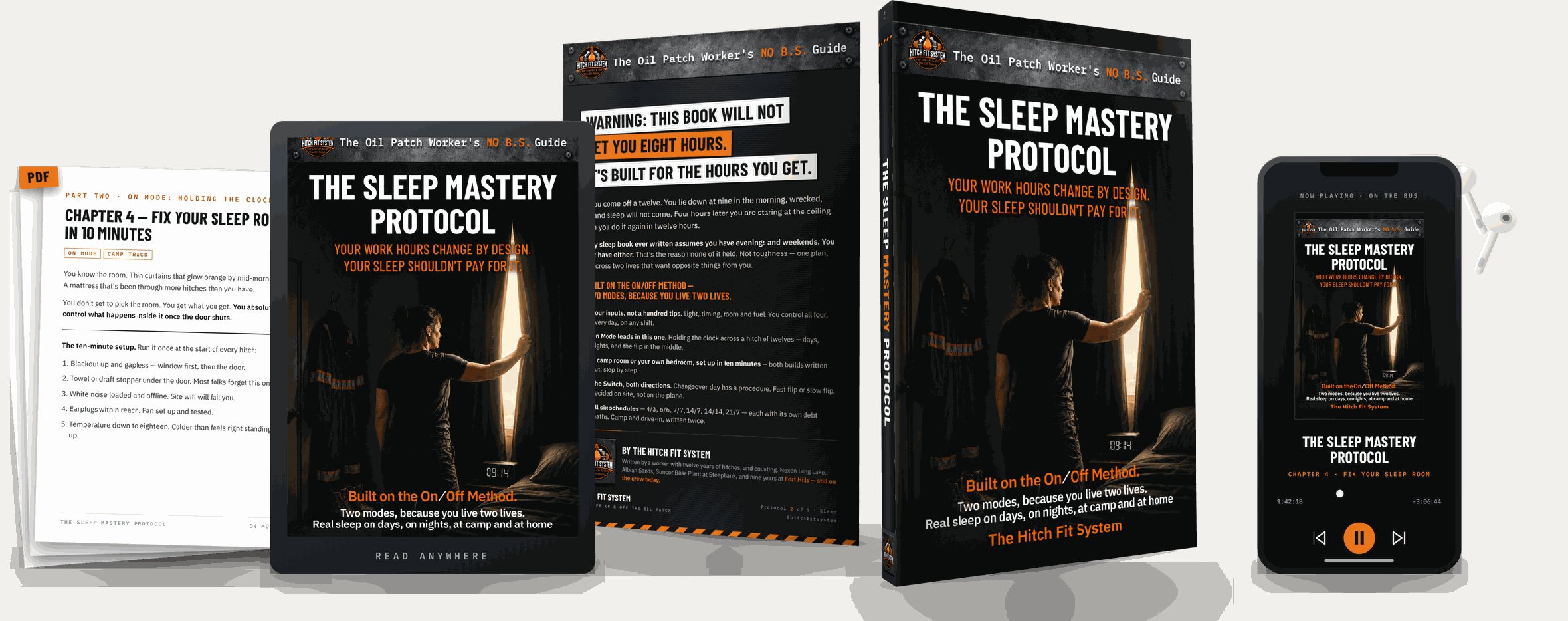
These are sections inside the book, not separate downloads. Nothing to chase, nothing to lose.
Everything above, on your next hitch.
Try It For Three Hitches — $67Book · audiobook · 1 field card · App free 120 days, then $27/mo, cancel anytime · Full refund inside three hitches, keep everything
Or take all five — Founding Crew $197 · 100 seats · Closes October 10
Get all five instead — $197 →Get all five — The Complete System $297 →
Before you buy, the honest part
Included · Every copy, every tier
Here's the honest problem with everything in this guide. It works, and it's also a lot to hold in your head on four hours of sleep, six days into a hitch.
A cutoff that moves every time your schedule does. A light procedure with five versions. A tracker you stop filling in by day four.
A notebook and a phone alarm can run all of this, and plenty of folks do exactly that.
But a method that lives in your memory falls apart right when you need it most. Deep into a rough hitch, exhausted, when discipline is hardest.
Tell it your mode and your shift. Every light window, cutoff and reminder recalculates itself. No doing arithmetic at two in the morning trying to remember what a chapter said.
Set your hitch — 4/3, 6/6, 7/7, 14/7, 14/14, 21/7, or your own pattern. The flip rules then apply themselves. It knows a 14/7 doesn't get handed 14/14 advice.
Log the coffee as you drink it. You get a countdown, and a nudge at the moment willpower is weakest. Which is the only moment a nudge is worth anything.
A ten-second daily log. It takes less time than reading this sentence, which is the entire reason it survives past day four.
Trends show you which hitches you slept best on, and what was different about them. Pattern instead of guesswork.
You walk into that appointment with your log instead of your memory. Chapter 13 tells you exactly what to bring and what to ask for.
You set your schedule and your mode. It builds your first hitch's windows — cutoff, wind-down, sleep window — and puts them on your phone.
Last shift of the hitch, it asks which flip you're running and sets both alarms while you're still on site. Which is exactly where Chapter 10 says to decide.
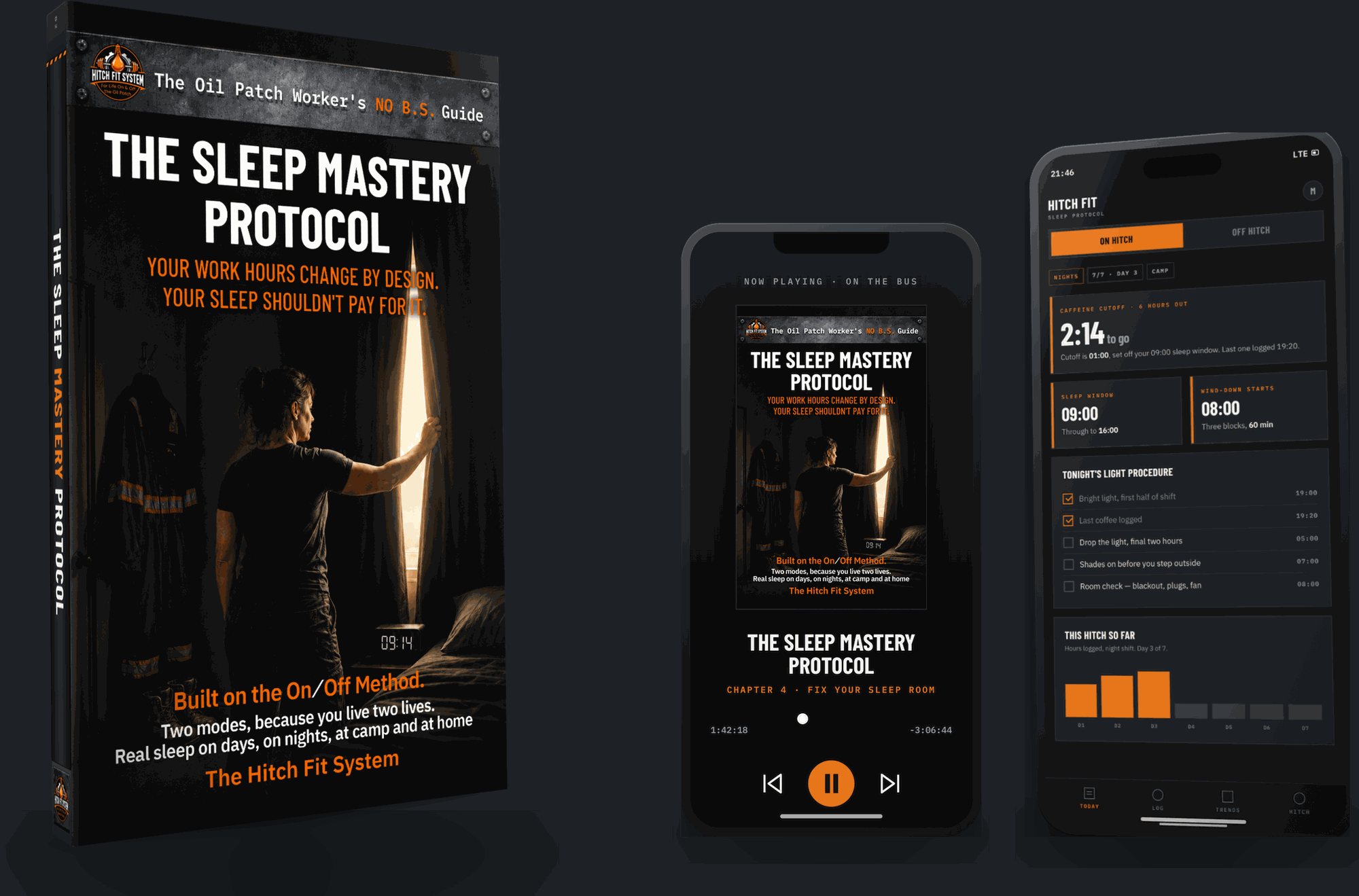
The book on the shelf. The app on the shift.
Get It On The Bus TonightBook · audiobook · 1 field card · App free 120 days, then $27/mo, cancel anytime · Full refund inside three hitches, keep everything
Or take all five — Founding Crew $197 · 100 seats · Closes October 10
Get all five instead — $197 →Get all five — The Complete System $297 →
The price
Put it against the things you're already buying to cope with this.
Built on the On/Off Method — two modes, because you live two lives.
The Sleep Mastery Protocol · book + audiobook + field card + the app
Stop Losing The First Two Days Off — $67Book · audiobook · 1 field card · App free 120 days, then $27/mo, cancel anytime · Full refund inside three hitches, keep everything
Or take all five — Founding Crew $197 · 100 seats · Closes October 10
Get all five instead — $197 →Get all five — The Complete System $297 →
There's also the Complete System at $297 — all five Protocols, all five audiobooks, and the app.
Because your body is not the only thing the hitch is taking. The other four Protocols are Body, Drive, Days Off and Hitch to Home.
My “measured in hitches, not days” guarantee
A fourteen-day refund window is useless to you. You might not even finish one hitch inside it.
So this one is measured the way your life is measured.
Run it for three full hitches. Not read it — run it. If it hasn't earned its place in your kit by the end of hitch three, email us and we'll refund you in full. You keep the books.
Notice what that's a guarantee on. The method, not your results.
I'm not going to promise you hours of sleep and then hide behind small print when your body does something else. That's the trick this whole page is built to avoid.
Outer window 120 days, so a long schedule still clears three hitches comfortably.
Three hitches to find out.
Yes — Send Me The ProtocolBook · audiobook · 1 field card · App free 120 days, then $27/mo, cancel anytime · Full refund inside three hitches, keep everything
Or take all five — Founding Crew $197 · 100 seats · Closes October 10
Get all five instead — $197 →Get all five — The Complete System $297 →
One thing that does run out
There's no cap on this book. No countdown on this page, no stock counter, nothing invented.
You can buy it in March and it'll be the same $67.
The one real constraint is the Founding Crew — the Complete System at $197 instead of $297. That adds lifetime updates, direct access and input on version two.
That's 100 seats and it closes October 10. After that it's $297 and the extras are gone.
That's the entire scarcity statement on this page. If you'd rather just take the one book, take the one book.
Here's what to do next
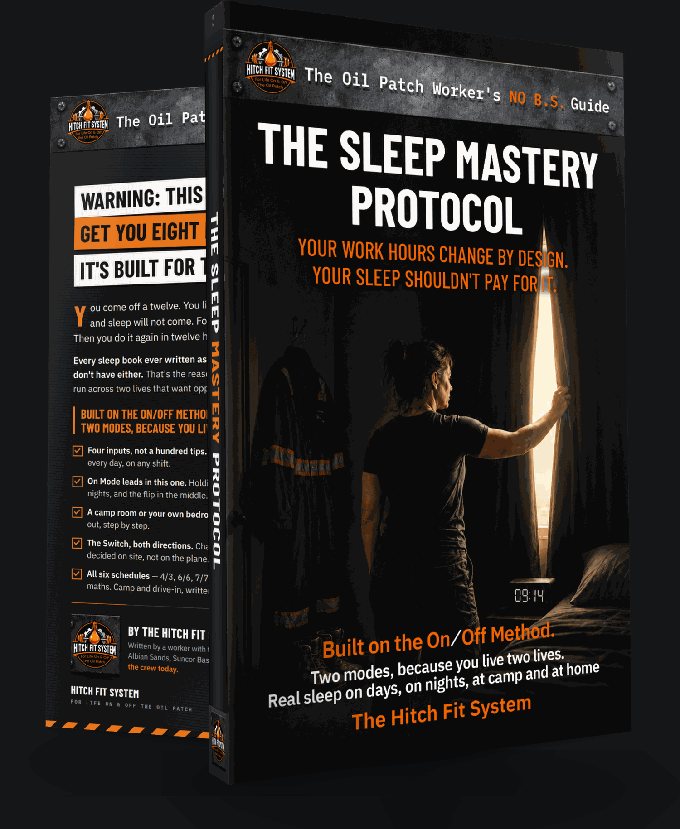
Built on the On/Off Method — two modes, because you live two lives.
Book + audiobook + field card + the app
Get The Sleep Mastery Protocol Now!Book · audiobook · 1 field card · App free 120 days, then $27/mo, cancel anytime · Full refund inside three hitches, keep everything
Or take all five — Founding Crew $197 · 100 seats · Closes October 10
Get all five instead — $197 →Get all five — The Complete System $297 →
Take one thing off this page and never buy anything. Put your shades on before you walk out the door, not once you're in the truck. That's the highest-value thirty seconds in the book, and it costs nothing.
Thinking "I'll fix my sleep after I sort my weight out"? That's backwards, and it's the mistake I made for six years. You can't recomp on four hours. You can't hold your drive together on four hours. Fix this one and the others get easier. Skip it and the others don't work at all.
Three full hitches. If it hasn't earned its place by the end of hitch three, you email us and we refund you. You keep the books. Worst case, you're out nothing and you learned what a blacked-out room feels like.
— The Hitch Fit System
Fort Hills. Still on the crew.
Straight answers
Yes. Chapter 8 has a section for each of the six named schedules. Plus one written for patterns that don't have a name. You need two numbers: how long the hitch is, and how many usable days off you get.
No, and if it ever looks like it might, the cutoff loses. Safety first, sleep second, every time. Chapter 7 handles this properly. The short version is a coffee nap in the lot before you pull out, which gets you both.
No. Your body doesn't care how long you've been ignoring the signals. Folks who've been at it for decades often notice faster than newer workers. They've got a lot of rough nights to compare against.
Maybe, for about a week. Then they either start asking what you're doing differently, or they don't and it stops mattering. You're not running this for approval from the person next to you.
No. Sunglasses and a blackout setup cost less than a meal out and do more than everything else combined. A garbage bag and painter's tape works while the real one ships. Build the rest over your next few hitches.
Check the tracker honestly first. Most folks who say it didn't work ran two or three pieces consistently and skipped the rest. Run all four inputs for one full hitch, log it daily, then make the call. And if you ran it properly and it didn't move, that's Chapter 13. Some sleep problems are medical, and finding that out is a good outcome.
No. That advice is written for someone with a Tuesday and it's the fastest way to spot an outsider. This is about the sleep you can actually get on the schedule you actually work.
Yes, throughout, and it's named explicitly. The research on this workforce reports sleep as notably worse for women. Almost nobody in this category is talking about that.
You've got a better room and a harder problem, and you get your own chapter for it. Every procedure in the book is written twice where the camp version and the commuter version differ.
No. It's free for 120 days — the whole guarantee window — then $27 a month, and you can stop it whenever you like. That's the case across the whole system, not just this Protocol.
Everybody needs their own copy. Partly that's how the licence works. Partly somebody's more likely to run something they paid for than a forwarded file. If your whole crew is fighting the same thing, mention it to your supervisor. Some sites will cover resources like this for a team.
If you're doing chores at five and driving to a twelve after, that's a fifteen-hour day with a different name on it. Chapter 8's last section is for exactly this — two numbers, and you've built your own version.
However many hitches you've got left. Sleep through more of them.
Take The Flip Off Autopilot — $67Book · audiobook · 1 field card · App free 120 days, then $27/mo, cancel anytime · Full refund inside three hitches, keep everything
Or take all five — Founding Crew $197 · 100 seats · Closes October 10
Get all five instead — $197 →Get all five — The Complete System $297 →